Walks along the canal and edible mapping – Wester Hailes

51252521_10156979352120522_1856259121297227776_n

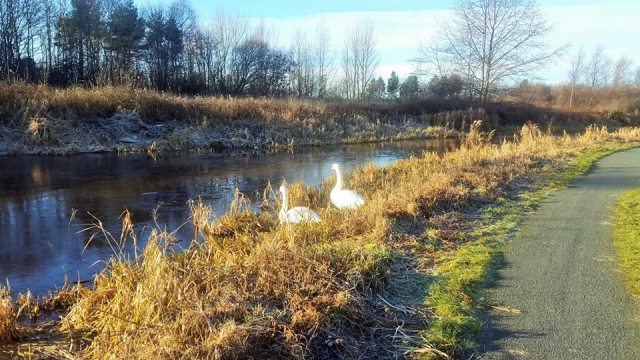
I thought I would start off our blog posts for Water Logic with a short commentary on Group 2’s edible mapping experiences so far. Yesterday we took our second walk along the canal with community group members. This time we began in Wester Hailes, walking from Calder Road to West Side Plaza, passing the Bridge 8 Hub, a social enterprise providing access to sustainable outdoor activities such as cycling and canoeing, a former community garden that has fallen into disuse and Westburn Woods which has been the site of a community project. Along with these points of interest, we also came upon what we surmised to be a mated pair of swans, a definite highlight of the canal journey. I think we all felt the contrast between the relative quiet along the Wester Hailes route and the bustle and general city noises heard along our first route last week, where we started at the Union Canal Basin. Redevelopment will occur on either side of the Foutainbridge route, with the two brownfield sites that FCI have described and planning by Glencairn to re-develop part of Lower Gilmore Place which includes an associated application to Sustrans for a pedestrian/cycle route that integrates vehicle access and parking (I learned the latter through FCI member, Simon Zisman).

It was apparent that the Wester Hailes route had areas that were just left, or abandoned, with lack of litter pick up on the opposite bank and an overgrowing community garden with remnants of a tended life (a bench was still visible on the plot). The ‘wildness’ out at Wester Hailes, however, provided some undisturbed habitats for these swans to nest, for instance, and also provided this human with a place that felt like a retreat from the city, in what felt like a transition zone moving from city to more remote countryside. Preserving this for local wildlife while engaging communities with the canal along this route, taking the context-specific advice from SCOREscotland, for instance, who have asked for consideration of widening some parts of the canal path, providing cycling and growing hubs, will be an important “balancing” act. I look forward to reading students’ thoughts and seeing photos and videos from our walks in subsequent posts!

Walks along the canal and edible mapping – Wester Hailes

51252521_10156979352120522_1856259121297227776_n

I thought I would start off our blog posts for Water Logic with a short commentary on Group 2’s edible mapping experiences so far. Yesterday we took our second walk along the canal with community group members. This time we began in Wester Hailes, walking from Calder Road to West Side Plaza, passing the Bridge 8 Hub, a social enterprise providing access to sustainable outdoor activities such as cycling and canoeing, a former community garden that has fallen into disuse and Westburn Woods which has been the site of a community project. Along with these points of interest, we also came upon what we surmised to be a mated pair of swans, a definite highlight of the canal journey. I think we all felt the contrast between the relative quiet along the Wester Hailes route and the bustle and general city noises heard along our first route last week, where we started at the Union Canal Basin. Redevelopment will occur on either side of the Foutainbridge route, with the two brownfield sites that FCI have described and planning by Glencairn to re-develop part of Lower Gilmore Place which includes an associated application to Sustrans for a pedestrian/cycle route that integrates vehicle access and parking (I learned the latter through FCI member, Simon Zisman).

It was apparent that the Wester Hailes route had areas that were just left, or abandoned, with lack of litter pick up on the opposite bank and an overgrowing community garden with remnants of a tended life (a bench was still visible on the plot). The ‘wildness’ out at Wester Hailes, however, provided some undisturbed habitats for these swans to nest, for instance, and also provided this human with a place that felt like a retreat from the city, in what felt like a transition zone moving from city to more remote countryside. Preserving this for local wildlife while engaging communities with the canal along this route, taking the context-specific advice from SCOREscotland, for instance, who have asked for consideration of widening some parts of the canal path, providing cycling and growing hubs, will be an important “balancing” act. I look forward to reading students’ thoughts and seeing photos and videos from our walks in subsequent posts!

Cockenzie 3

edinburgh-carlton-hill-landscape-scotland-161863.jpeg

On this programme, you will gain an understanding of the underlying principles of sustainable design and be able to make intelligent and informed decisions in your following career. It is not intended to provide narrow specialist technical training in an aspect of planning and construction but instead to equip you with the knowledge and expertise to create persuasive sustainable strategies realised through excellent design.

We encourage group working and learning from each other and actively encourage you to explore beyond the boundaries of your existing professional and academic skill sets.Our students come from architecture and related built environment disciplines in engineering and landscape architecture but we welcome anyone with a deep interest in design and sustainability. The programme is outward looking, with guest lecturers and critics throughout the session.  We run a field trip that explores cutting edge sustainable design and self-sufficiency that helps contextualise your learning.

On this programme, you will gain an understanding of the underlying principles of sustainable design and be able to make intelligent and informed decisions in your following career. It is not intended to provide narrow specialist technical training in an aspect of planning and construction but instead to equip you with the knowledge and expertise to create persuasive sustainable strategies realised through excellent design.

We encourage group working and learning from each other and actively encourage you to explore beyond the boundaries of your existing professional and academic skill sets.Our students come from architecture and related built environment disciplines in engineering and landscape architecture but we welcome anyone with a deep interest in design and sustainability. The programme is outward looking, with guest lecturers and critics throughout the session.  We run a field trip that explores cutting edge sustainable design and self-sufficiency that helps contextualise your learning.

Testing testing

HJORT 73
It has been shown that rural areas are attractive to families with children, perhaps adhering to the popular image of the rural as a good environment to raise children (cf. Borgega ̊ rd et al., 1993; Cloke et al., 1995). It has also been shown that there is a certain greying of the rural population reinforced by the in-migration of older people to the more remote rural areas in particular. It is not known whether these older in-migrants have returned to a rural home area or if they move to a particularly attractive environment, but it is known that rural areas are attractive to this particular group of people. In addition, it was noted that if self-employed people move, they are more attracted by rural areas than others. Perhaps self-employment is a precondition for a rural move or a rural move triggers self-employment. Irrespective of the reasons for being self-employed, it is an important ingredient in the livelihood strategies for rural areas.
The Attraction of the Rural 57